
Discuss these techniques with your orthopaedic surgeon before you practise them. Your physiotherapist may change some of them for your particular condition – age, weight, other complaints and the operation performed. Use only techniques approved or recommended by your doctor or physiotherapist.
Lying down
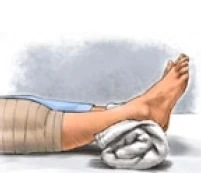
To make your knee more flexible while you are lying down, put a rolled-up towel under your ankle. When you relax the knee, you may feel a slight stretch in the thigh.
Sitting up from lying down
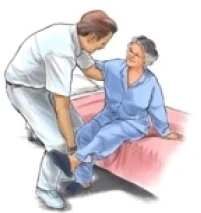
For the first few days your doctor or physiotherapist may move and hold your legs. Soon you will be able to sit on the bed without help, with your leg on a small stool. You will be told to tighten and relax the muscles of the operated leg.
Standing up with help
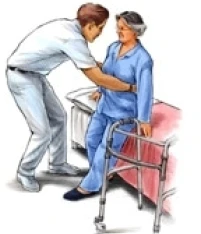
For a while your doctor or therapist may help you stand up. A belt may be put around your waist so that they can support you if you feel unsteady or dizzy. A splint may be put on the operated leg to avoid unwanted movement while you stand.
With a walker
Once you can stand up, you can use a walker to help you keep your balance. At first you will be told to put only a small part of your weight on the operated leg when walking. When the knee becomes more stable, your doctor will let you put more weight on it.
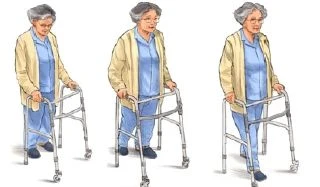
With both hands, lift the walker and move it a few centimetres in front of you. Make sure all four of its legs are on the floor before you go on.
Lean on the walker and move your body weight onto it. Step forward into the walker with the operated leg. Take care not to trip over its legs.
Hold the walker firmly with both hands, then step forward towards it with the healthy leg.
Walking with crutches
Once the muscles of your knee and leg are strong enough, your doctor or physiotherapist will let you walk with crutches instead of a walker. The physiotherapist will tell you how far and how long you may walk.
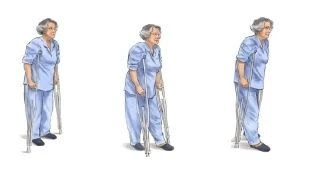
With the crutches firmly on the ground, put the pressure on your hands, not your armpits.
Move the operated leg and both crutches forward at the same time.
Look ahead and take the first step with the operated leg and the crutches, followed by the non-operated leg.
On stairs with crutches
Going up
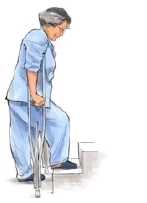
With the crutches upright on the floor and firmly placed for support, lift the non-operated leg onto the step. Lean forward on the crutches and raise yourself, letting the crutches and the non-operated leg carry your weight. Then lift the operated leg onto the step. At first you may need someone to help until you feel more confident on stairs.
Going down
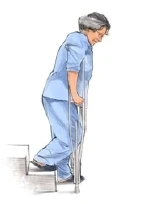
Put the crutches and the operated leg on the step below. Use the crutches for balance and step down carefully to the lower step, moving the crutches together with the operated leg. Again, you may want help until you feel more confident after the first few attempts.