
Discuss these techniques with your orthopaedic surgeon before you use them. Your physiotherapist may change some of them depending on your condition (for example your age, weight and type of operation). Use the techniques your doctor or therapist recommends.
Getting out of bed
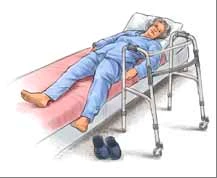
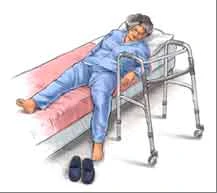
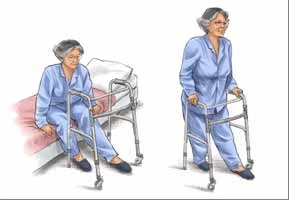
Always get out of bed on the same side – the side of the operated leg. Your doctor or physiotherapist will show you how to move your legs correctly and will help you with the first few attempts while you are in hospital.
To turn in bed, use your elbows. Keep your body and legs straight. Turning the operated leg is not allowed.
Move the non-operated leg to the edge of the bed, keeping the operated leg straight all the while. Hold on to the walker for support. Do not lean forward.
Sitting down
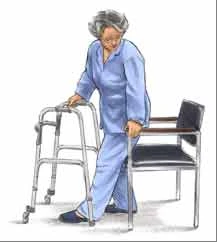
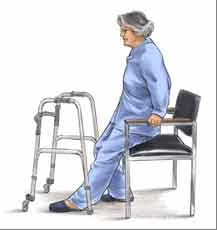
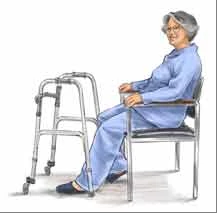
Sit on chairs with armrests, high seats and upright backs. Avoid low chairs. Feel the seat with your legs before you sit down.
Move your hands from the walker to the armrests, keeping the operated leg straight and forward.
Sit down by sliding into the chair. Bend the operated leg slowly, keeping an obtuse angle between it and your body. Use the same technique on the toilet.
Walking
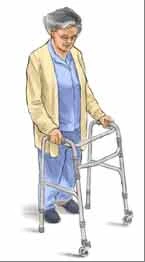
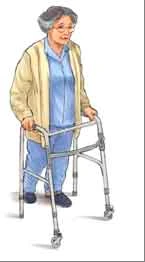
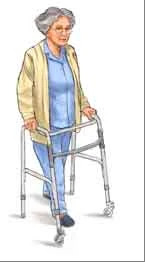
Once you can stand steadily with a walker, you can take your first steps. At first, put less weight on the operated leg. Your doctor will tell you when to put more weight on it.
Place the walker a little way in front of you and hold it firmly with both hands. Keep the hip straight and step with the non-operated leg into the middle of the walker. Avoid turning the operated hip.
Lean on the walker with your full weight. Step forward with the operated leg. Take care not to trip over the legs of the walker.
Lift the walker forward (if it has no wheels). Remember to put all four of its legs on the floor before you move your body forward. Repeat.
Crutches
Once your muscles are strong enough, your doctor may recommend crutches. Your physiotherapist will tell you how much and how long you may walk. When using crutches, your weight should rest on your palms, not your armpits. Your doctor will tell you how much weight you may put on the operated leg.
Stand firmly with the crutches, pressing on your palms and not your armpits.
Move the operated leg and both crutches forward at the same time.
Look ahead and take the first step between the crutches with the operated leg, followed by the non-operated one.
Going down stairs with crutches
Put the crutches and the operated leg on the step below. Use the crutches for balance and step down carefully. At first you may want someone to help you with the first few attempts.
Going up stairs with crutches
Stand upright with your crutches next to the stairs and lift the non-operated leg onto the step. Using the crutches and the non-operated leg, raise yourself up. Then lift the operated leg and put it next to the healthy one on the step. You may want someone to help you with the first few attempts until you get used to it.
Avoid the risky movements
After a hip replacement some movements are dangerous for the new joint: they can make it dislocate (luxation). Your doctor will teach you which movements to avoid. Some of the riskiest are:
When you are at home
It is very important to follow your surgeon’s instructions. Discuss the following with your doctor before you leave hospital:
- If you will use crutches or a walker, ask your doctor how much weight you may put on the operated leg.
- You will most likely tire more easily than usual. Plan a rest of 30 to 60 minutes in the morning and in the afternoon.
- Avoid low furniture. For more comfort, sit on a cushion.
- A raised toilet seat reduces the strain on the hips and knees.
- A bath seat (bench) lets you sit while washing, for more safety and comfort.
- Avoid sweeping or vacuuming.
- You may ride in a car, but follow your doctor’s instructions on getting in and out. You can raise the car seat with cushions to protect the hips and knees.
- Your doctor will tell you when you may drive – usually four to six weeks after the operation. If your car has a manual gearbox, ask about extra restrictions. Make sure you can use the brake without trouble before you drive in heavy traffic.
- Constipation is common after an operation, usually because of limited movement and the painkillers. Discuss your diet with your doctor: fresh fruit and vegetables and eight glasses of fluid a day, unless your doctor tells you otherwise.
- Your doctor will probably prescribe painkillers. Follow the instructions for them.
- Swelling around the wound is normal. Looser clothes reduce the pressure on the wound. Ask your doctor or another healthcare professional how to care for the wound.