
The hip joint
The hip joint is formed by the head of the thigh bone (femur) and the socket of the pelvis (acetabulum). It is the main link between the bones of the leg and the skeleton of the trunk and pelvis.
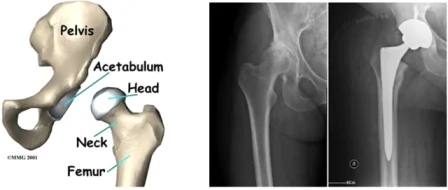
Where the femoral head and the acetabulum touch, they are covered with smooth tissue called articular cartilage. The cartilage, together with a substance called synovial fluid, reduces the friction between the bones and protects them from damage.
The main cause of hip disease is wear of the articular cartilage, known as coxarthrosis. The wear is felt as pain – at first only with movement and when the joint is overloaded, then more and more often, and finally at rest as well.
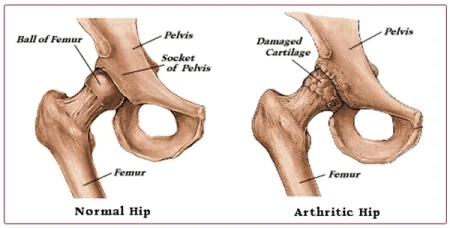
The pain grows and becomes more frequent, until it is constant. It is a very slow process that goes on for years, and in the end it can lock (stiffen) the hip joint.
Surgery is most often needed because of severe arthrosis (coxarthrosis). Successful surgery brings dramatic relief from pain and better function of the hip.
Why a total hip replacement?
With a history of almost 70 years, total hip replacement is a very common and safe procedure for treating severe arthrosis. The main benefits of a successful hip replacement are, in general:
- less pain in the hip, and later no pain at all;
- movement restored in the joint;
- a better quality of life – your daily activities and social life will no longer be limited by pain and stiffness.
The operation can be done in different ways: with “conventional” surgical techniques or with minimally invasive surgery. Minimally invasive surgery can potentially give you:
- a smaller scar;
- a shorter stay in hospital;
- less blood loss;
- a faster recovery.
Not every patient is suitable for minimally invasive surgery. Whether it is possible in your case – ask your orthopaedic surgeon.
Hip replacement surgery (arthroplasty)
Hip arthroplasty will help you enjoy an active life free of pain. The implant will help you return to many of the activities you gave up because of the pain, and give you more freedom and confidence.
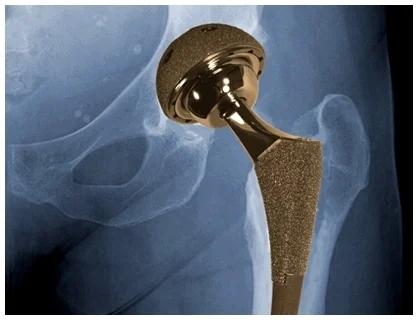
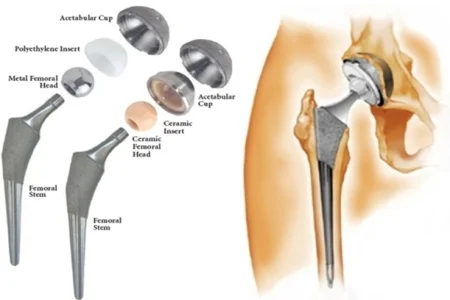
A hip replacement replaces the damaged bone and cartilage with ceramic, metal and plastic components.
The stem is usually made of an alloy – steel or titanium – which ensures the greatest biological compatibility. It is fixed to the bone directly or with bone cement.
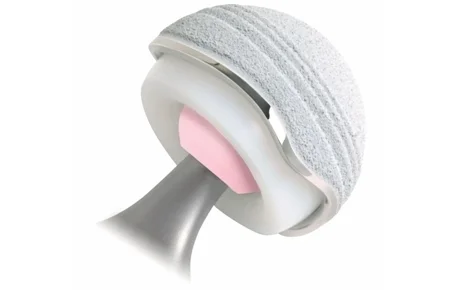
The head is made of ceramic or metal. The cup, which is fixed to the pelvis, is made of an alloy or titanium with a porous surface, which ensures good integration with the bone. A liner of polyethylene, metal or ceramic is placed inside it, which gives the joint a very long life. The cup can also be made of a special polymer; it is then fixed to the pelvis with bone cement.
Anaesthesia for hip surgery
A hip replacement can be done under general, spinal or epidural anaesthesia. A combination of techniques is often used. Your anaesthetist will suggest the best anaesthesia in your case.
General anaesthesia
The patient is asleep during the procedure, and breathing is supported by a machine. Many patients feel drowsy or very weak after a general anaesthetic. Modern medicines greatly reduce nausea and vomiting after the operation.
Spinal or epidural block
These techniques block nerve impulses, including pain, in the spinal cord. They are regional anaesthesia. The block can be placed at different levels of the spine, but the patient usually has no sensation from the waist down. Depending on the medicines used for the block, pain relief can last several hours after the operation, so fewer painkillers are needed. Because these blocks cause a temporary loss of sensation below the waist, a urinary catheter (a tube into the bladder to drain urine) is often needed.
Possible complications
Every surgical procedure carries risks and possible complications. Although they are unusual in modern joint replacement, the following sometimes occur:
- Blood loss that needs a transfusionEvery joint replacement involves blood loss, which often needs an additional transfusion. With precautions, the loss is kept to a minimum during the operation. Some patients may be able to donate blood before their own operation and then receive their own blood back (autotransfusion).
- InfectionEvery operation is done through a cut in the skin and carries a potential risk of infection. Many precautions are taken during the operation to reduce it. Intravenous antibiotics are always given during and after the operation. The operating theatre has special airflow equipment that keeps bacteria in the air to a minimum.
- Blood clots in the legs (deep vein thrombosis)Slower blood flow in the veins (venous stasis) can cause blood to clot. A blood-thinning medicine greatly reduces this risk and is given to every patient. Despite this prevention, a very small percentage of patients may develop clots in the leg.
- A blood clot in the lungs (pulmonary embolism)Sometimes clots in the legs can break off and travel to the lungs. This complication, although extremely rare, can be life-threatening. Symptoms include chest pain and shortness of breath.
- Nerve injuryAny surgical cut can damage the sensory nerves in the area of the cut. Significant nerve damage that could lead to loss of muscle function is extremely rare.
Complications are quite rare, and a few simple rules can sharply reduce the chance that they happen. Knowing these risks will help you avoid them.
What to do before the operation
An infection or inflammation will be a reason to postpone the operation!
Any source of infection is incompatible with fitting an artificial joint. An infection elsewhere in the body can lead to an infection of the implant. It is therefore absolutely necessary to clear every sign of infection before the operation:
- have your teeth checked, and any other infection in the mouth;
- check your feet for fungal infection, ingrown nails, spots or wounds that have not healed;
- in the last days before the operation, shower morning and evening with an antiseptic soap to reduce the germs on your skin.
Remember to bring to hospital
- a full list of the medicines you take every day, with doses and times;
- all documents for admission, including copies of discharge summaries from earlier hospital stays;
- everything your doctor asked for (toiletries, slippers, crutches and so on).
The operation takes about 1 to 2 hours. It is preceded by special preparation.
After the operation
Specialised medical staff will look after you from the first day after the operation and will set the rehabilitation programme that suits you best. Follow your orthopaedic surgeon’s instructions strictly to keep all possible complications to a minimum. This will benefit your quality of life and the life of the implant.
In rare cases there may be a slight difference in the length of the two legs after the operation. It is usually caused by stiffness of the neighbouring joints or by a difference that existed before the operation, and it disappears after a few days. A heel insert on one shoe may be needed to correct it.
Activity after the operation
There are very few restrictions after a hip operation. It is extremely important that patients move and exercise the hip in the early days after the operation, to regain the best possible function. Physiotherapy usually starts on the first day after the operation or on the day of the operation itself. The exercises are described in the rehabilitation guide.
Recovery time
~80%of patients recover fully within six weeks of the operation
3–6months during which the condition keeps improving gradually
15–30+years of trouble-free function of the artificial hip can be expected statistically
Recovery time varies. It depends on the state of the patient’s nervous system, their persistence, the state of the joint before the operation (how worn it was) and the quality of the rehabilitation.
How long the implant lasts
Hip implants have an unlimited life. Statistically, 15, 20, 30 or more years of trouble-free function of the artificial hip can be expected. Earlier loosening occurs with severe obesity, intense physical activity (heavy physical work) or, in some cases, for unclear reasons. The implant then has to be replaced early.
- Lead a healthy and active life.
- If you have a fever, a sore throat, a chest infection or something similar, tell your doctor that you have an artificial hip.
- Attend the follow-up check-ups your surgeon sets.
- Whenever you are worried about your artificial joint, see your surgeon.